


Giving feedback should not require choosing between being kind and being clear.
Farrah Mitra is one of 12 certified Radical Candor facilitators worldwide, with more than 200 workshops delivered across Fortune 50 companies, hyper-growth startups, and global nonprofits, including organisations like Google, Indeed, Accion, and Medallia. Her programmes average 4.8 out of 5 across 355 participants, with 95 percent giving 4s or 5s. Leaders leave with a shared language they actually use, not a feeling that fades by the following Monday.
Honest feedback, without the sandwich, without the flinch.
Why Feedback Goes Wrong
Leaders often avoid feedback because they are worried about the reaction. Others give feedback so indirectly that the person never actually understands what needs to change, and the issue stays unresolved for months, sometimes years.
Both approaches create problems. Vagueness is not kindness.
Watered-down feedback leaves people guessing and problems unresolved. Effective feedback requires clarity, respect, and the willingness to actually have the conversation rather than talk around it, hoping the person picks up on what is not being said.

Building a Feedback Culture
A feedback culture is not created by a values statement on a wall. It is built through repeated behaviour, modelled from the top down, session after session, until it becomes the norm rather than the exception. Leaders need a shared language, confidence in difficult moments, and practical ways to give and receive feedback without turning every conversation into a confrontation.
Farrah has worked with leadership teams across industries and organisation sizes, from Series A startups to Fortune 50 companies, to build exactly that capability. What is always the same, regardless of industry or seniority level, is this: the leaders who do the internal work first are the ones who get the external results that stick.
Teams do not build psychological safety by deciding to have it. They build it by practicing the specific behaviours that create it, repeatedly, until it holds under pressure.
Why Most Feedback Training Does Not Stick
Most feedback training is a single session: a slide deck, a framework explained once, maybe a role-play exercise, and then everyone goes back to their desks and reverts to old habits within a week.
The reason it does not stick is not that the content was wrong.
It is that behaviour change requires repetition and real practice under conditions that resemble the actual stakes, not a one-off explanation. Farrah's workshops are built around real vulnerability and real practice specifically because that is what separates a session people remember fondly from a session that actually changes how a team communicates six months later.
What a Feedback Culture Actually Looks Like Day to Day
It is not a quarterly review process or an anonymous survey.
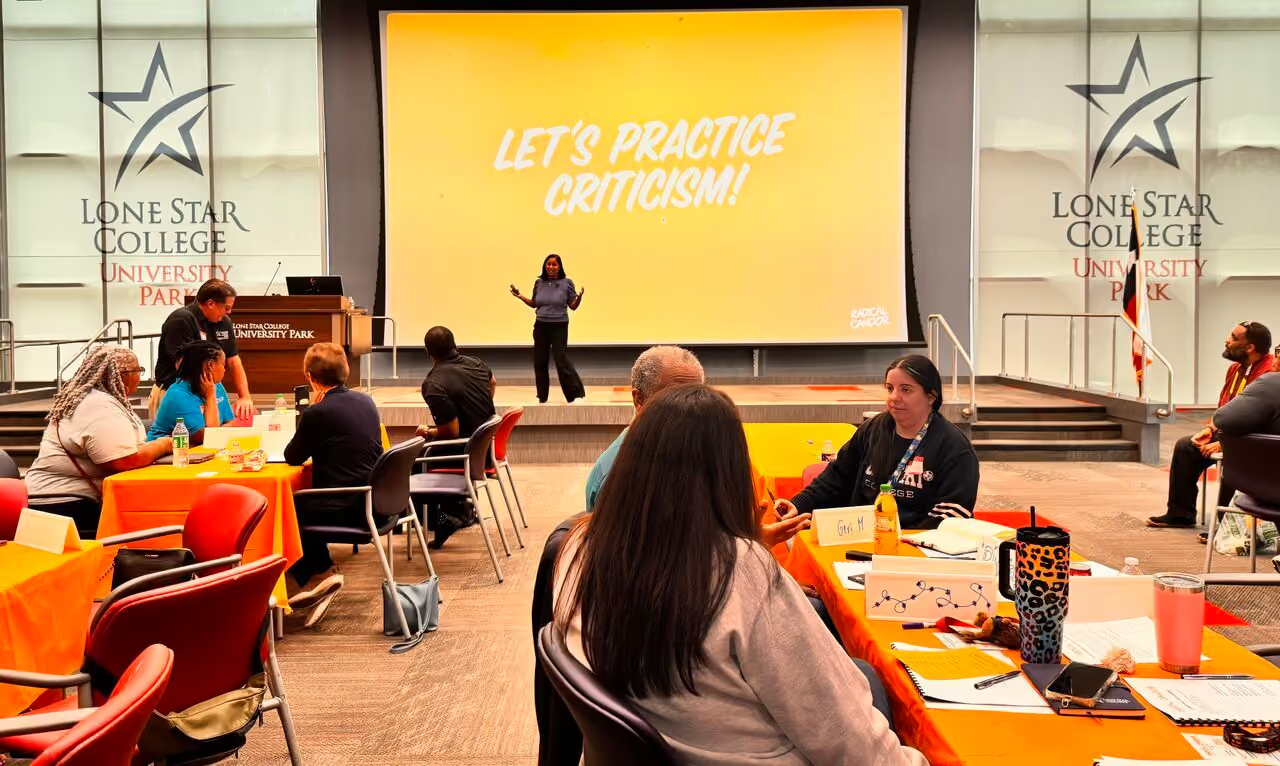
Using a proven facilitation methodology, workshops are delivered with real vulnerability, real examples, and real practice that sticks, not a good day followed by a return to old patterns.
None of these moments are dramatic on their own. Together, repeated across a team over months, they are what psychological safety and honest communication actually look like in practice, rather than as concepts on a values slide.
What Makes This Different
This is not a lecture.
Using a proven facilitation methodology, workshops are delivered with real vulnerability, real examples, and real practice that sticks, not a good day followed by a return to old patterns.
Format options include half-day or full-day sessions for teams of any size, Myers-Briggs workstyles integration, and post-workshop team follow-up included as standard, so the change does not stop the moment the session ends. A room where something actually changes, not just a talk that inspires for 48 hours and fades by Monday.
The Radical Candor Facilitator Difference
Most facilitators understand feedback theory. This comes from someone who has been in the room delivering it.
Twelve years at Bain, then Sr. Director of People at Medallia and VP of People at Alto Pharmacy, means the frameworks taught here were tested in real rooms with real stakes, not developed in the abstract.

Receiving Feedback, Not Just Giving It
A feedback culture requires two skills, not one.
Giving direct feedback is only half the equation.
Leaders also need to model how to receive it, without becoming defensive or apologetic, and without dismissing feedback that is uncomfortable to hear. Teams watch how leaders respond to feedback about themselves more closely than they listen to what leaders say about giving it. Modelling that response is part of every workshop.
Your leaders are
carrying more than they need to. Let's change that.
High-performing leaders do not need more pressure. They need the confidence, clarity, and practical tools to lead difficult moments without burning themselves out. That work starts with a 30-minute conversation.